


How To: Use Stories to Reinforce Vocabulary

Updated: May 21
Lesson Objective: Analyze and sort words with targeted morphemes as they appear in a passage; demonstrate comprehension by identifying character feelings and write an sequel or alternative ending to the story.
Methodology: Students read a passage containing words with the targeted morphemes. After highlighting, students sort and define vocabulary words. Last, they identify character feelings through emojis and write an sequel or alternative ending to the story using vocabulary terms
Duration: 30-40 minutes for two periods.
Yup, another sorting activity!
As mentioned in How To: Spell & Sort Morphemes, I find sorting activities not only therapeutic, but also powerful as an instructional strategy. When students sort morphemes, by type (prefix, base, suffix) or by meaning, they strengthen their understanding of how words are constructed. Our brains are wired to remember information that’s been grouped or categorized, and sorting taps into that natural tendency, making it easier for students to retain what they learn.
Sorting also encourages metacognition, as students must justify their choices and explain their reasoning. It transforms abstract ideas into concrete understanding. A prefix like pre- becomes much more meaningful when students sort it alongside words with post-, re-, or un-. They begin to notice nuances, patterns, and exceptions—all key to building a flexible, deep vocabulary.
If you have the time, I highly recommend writing the passages yourselves so you can include student names and interests. Student engagement increased significantly when I began this practice, especially given the shortage of high-interest/low-readability literature available for high schoolers. I also teach Creative Writing, so this was not a chore.
 |  |
🖍 How the Routine Works
First, we briefly review the target morphemes and their definitions. Students silently read the passage to themselves while highlighting the target morphemes. I ask students to quietly read to me at least once so I can check for fluency and accuracy. By mid-year, most students are comfortable enough with each other that they prefer to read aloud, especially if they anticipate a particularly comedic passage.

I ask students to read the passage again, this time with a focus on fluency now that they're not simultaneously highlighting. Afterwards we'll engage in some summarizing and retell questions. Students sort the words from the story by morpheme and match some of the terms to definitions. I sometimes include at least one “trickster” word to reinforce that morphemes must have meaning. I often direct them back into the story to use context clues.
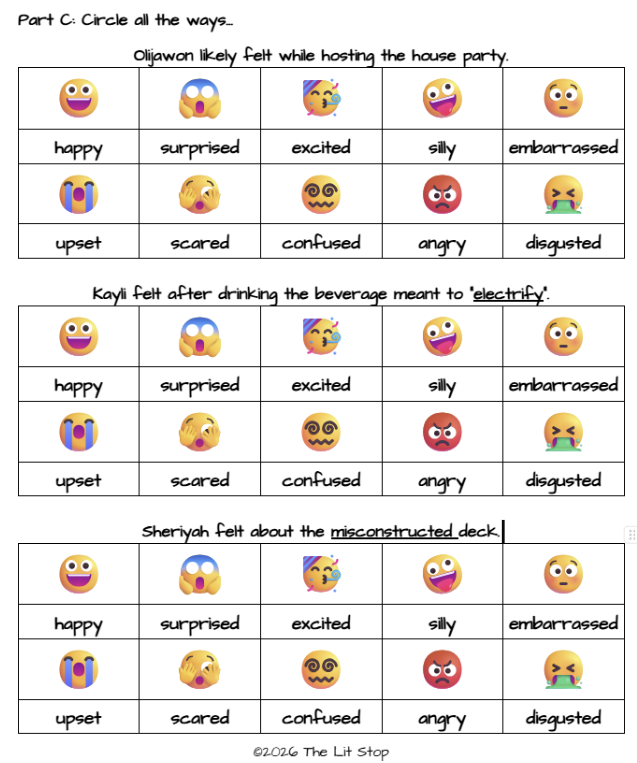
Last, students are expected to go a bit deeper with comprehension. They identify character emotions through emojis and write an sequel or alternative ending to the story using vocabulary terms. Students often find this challenging. While our targeted terms are hopefully in students' receptive vocabulary by now, it takes much more exposure for the words to become part of their productive vocabulary. If they're stuck, I ask them to brainstorm aloud and then I lead them to terms that fit their narrative. I may provide a sentence frame. I also find that it helps to ask students if they need a person, place, thing, action, or describing word, reinforcing the role of parts of speech.
 |  |
Check out the Interactive Unit Guides to see how this lesson fits within each unit. There, you’ll find links to unit-specific stories.


Comments