


How To: Syllabicate

Updated: Mar 4
Lesson Objective: Apply phonological knowledge to syllabicate words.
Grouping: Small-group
Methodology: Students apply a practiced syllabication method to a curated word list, each word chosen to highlight a targeted phonological pattern. The lists specific to each concept can be found within each Interactive Unit Guides.
Duration: 10-20 minutes, three-four times per unit
syl·lab·i·cate
As expected, there's more than one school of thought when it comes to syllabicating. IMSE's OG Comprehensive+ recommends teaching all six syllable types and four syllable patterns throughout the year. There's a major focus on identifying each syllable pattern. I found this to be...just too much for students. Too much annotating, too much memorizing, too much guesswork. I once again had to ask myself: Well, what do I do IRL when I encounter an unknown word? What is realistic here? I do not identify syllable patterns, and, honestly, wasn't even aware of them until I took the training. So, what do I do? I can best sum it up in the anchor chart below.

I am thankful I went with my gut and switched to teaching this more efficient process! Syllabicating suddenly clicked for students. Quiz scores increased while my need to assist during progress decreased.
When compiling my words for syllabication, I'm careful to only include words with spelling
patterns that have been taught. I cover up the "do not split" part of the poster until those
concepts have been taught. I'll peel back that tape as each is introduced.
Note that the concept of a syllable should have
already been taught before diving into
syllabication. For me, it's introduced during the first unit, Foundations, as shown in the work samples in the videos above.
🖍 How the Routine Works
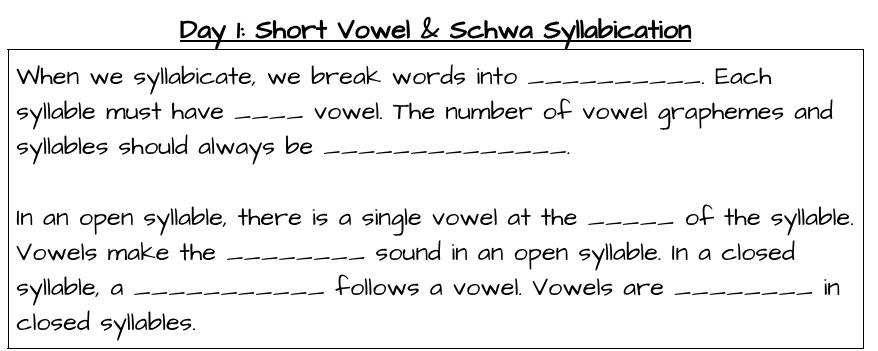
First, we review relevant syllabication rules and vocabulary. The samples below demonstrate the emphasis on particular rules for the short vowels at the beginning of the year versus diphthongs midyear.
 |  |
Next, I loosely follow the “I do, we do, you do” model. For the first word, I demonstrate the full process: identifying any morphemes, locating the vowels, circling chunks, and finally sounding out the word one syllable at a time. We double-check our syllable count using the classic chin drop method.
As I model, I write everything on chart paper visible to the whole group. We also record the

number of syllables and vowels—giving me yet another chance to reinforce their relationship. Did I mention I love repetition? Because I do. I make students compare the two numbers every. single. time. all year long to ensure that the numbers always match!
Once we've syllabicated the word, we highlight the targeted phonological pattern. As we continue, I gradually release responsibility by pulling back on the scaffolding. Students begin breaking the words into syllables independently and work at a semi-self-paced rhythm while I circulate to provide feedback.
The video to the left includes of syllabication video taken mid-year towards the end of the <y> as a vowel unit. The student's English Proficiency Level is three (according to WIDA scores). You'll see that he can fairly quickly identify the vowels and syllables but is still working on applying <y> as a vowel phonological patters. I think this unit is particularly challenging for Spanish speaking students because <y> follows a completely different set of rules in English.
I keep two to three days worth of dictation stapled in a packet. Students house these in their folders until it's time to turn it in upon completion.
Check out the Interactive Unit Guides to see how this lesson fits within each unit. There, you’ll find links to the unit-specific Syllabication lessons.


Comments